
Somewhere around 25 or 26, a quiet, uncomfortable thought starts showing up on your commute, in the shower, right before you fall asleep:
“I don’t think I want to do this for the next 30 years.”
Maybe you took this job because it paid well, or your parents were relieved, or it just seemed like the sensible next step after college. And it was sensible. But three years in, the spreadsheet you built your life around doesn’t add up to excitement anymore. It adds up to Sunday-night dread.
Here’s the thought that usually follows, and the one that keeps most people stuck:
“It’s too late. I’d have to start from zero.”
It’s not true. But it feels true, and that feeling is expensive, because it quietly convinces smart, capable people to stay in careers that no longer fit, for years longer than they should. Let’s take that fear apart, piece by piece, and replace it with an actual plan.
Why 25 Feels Like a Deadline (And Why It Isn’t)
There’s a myth that career paths are linear, moving from school to a first job, promotions, and retirement, and that switching lanes mid-way means restarting the whole race.
In reality, your career is a portfolio, not a straight line. Every year you’ve worked has given you something transferable, even if it doesn’t look like it on the surface:
- Communication and stakeholder management
- Project ownership and deadline discipline
- Problem-solving under real, not academic, pressure
- Domain knowledge that overlaps with more industries than you think
- The simple, underrated skill of being employable, which means showing up, delivering, and being trusted
A 25-to-30-year-old switching careers isn’t starting from zero. They’re starting from a base with 3-5 years of professional maturity that a fresh graduate doesn’t have. That’s a real advantage; you just have to know how to reframe it.
The Real Cost of Staying vs. The Real Cost of Switching
Before we talk strategy, let’s be honest about the math, because “starting from zero” is usually a fear about money and time, not ability.
The cost of staying in the wrong career:
- Years of experience building expertise in a field that doesn’t excite you — expertise that gets harder to walk away from the longer you wait
- Slower growth, because disengaged people rarely perform at their peak
- A compounding opportunity cost: every year in the wrong lane is a year not spent building momentum in the right one
The cost of switching:
- A temporary pay cut or lateral move (not always — more on this below)
- A learning curve, usually 6-18 months, not years
- Some initial discomfort of being “junior” again in a new domain
When you actually put both columns side by side, staying stuck often costs more. It’s just a slower, quieter cost, so it doesn’t feel urgent until you’re 35 and further from the version of your career you actually wanted.
The Bridge Strategy: How to Switch Without Free-Falling
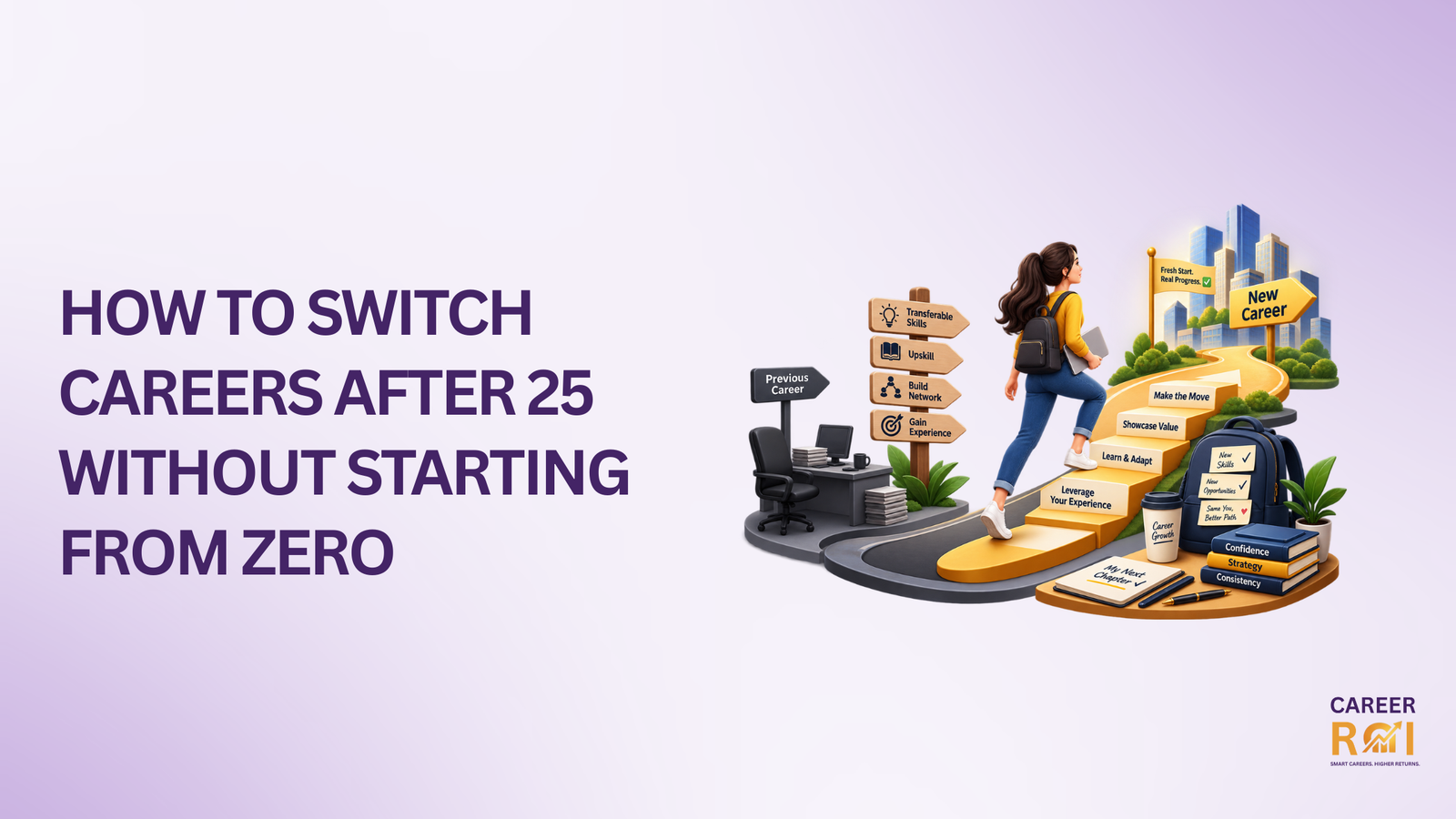
The people who switch careers successfully after 25 rarely do it by quitting on a Friday and starting fresh on a Monday. They build a bridge, creating a set of overlaps between where they are and where they want to be, so the jump is shorter than it looks.
1. Find your transferable core, not your job title
Don’t ask “what have I done?” Ask “what have I actually gotten good at?” A salesperson moving into marketing already understands customer psychology. An accountant moving into fintech already understands the financial systems the product is built around. Your job title is narrow. Your skill set is usually wider than you give it credit for.
2. Upskill in public, before you need to
Don’t wait until you’re desperate to learn. Take a certification, build a small project, freelance on the side, or contribute to something visible in the new field while you’re still employed and financially stable. This does two things: it de-risks the switch, and it gives you real proof (not just interest) to show a future employer.
3. Target the overlap roles first, not the dream role
You don’t have to leap from Sales Executive to Product Manager in one move. A role like Customer Success or Business Analyst might sit exactly at the intersection of what you know and what you want to know, providing a natural stepping stone that both companies and your own confidence will find believable.
4. Rewrite your story, don’t hide your past
The biggest mistake career-switchers make is treating their old career like a mistake to bury. Reframe it instead: “I spent 3 years in operations, which taught me how businesses actually run, and now I want to apply that to product, where I can build the systems I used to manage.” That’s not a weakness. That’s a narrative recruiters remember.
5. Expect a step, not necessarily a fall
Yes, some switches involve a temporary pay adjustment. But plenty of switches, especially into growing fields like data, product, UX, or tech-adjacent roles, pay more, not less, once you’re 12-18 months in, because you’re combining your old domain expertise with new in-demand skills. Don’t assume “switch” automatically means “downgrade.”
A Realistic Timeline (Not the Instagram Version)
Nobody switches careers in three weeks, and anyone promising that is selling something. A more honest picture:
- Months 1-3: Explore. Talk to people already in the field. Take one certification or short course. Confirm this isn’t just a grass-is-greener mirage.
- Months 4-9: Build proof using freelance projects, a portfolio, a certification, or volunteer work, providing something tangible beyond “I’m interested.”
- Months 9-15: Start applying for bridge roles, not dream roles. Use your existing network aggressively, as most career switches happen through referrals, not cold applications.
- Months 15-24: Consolidate. You’re no longer “the person who switched careers.” You’re just someone doing the new job, and doing it well.
Two years sounds long when you’re impatient at 25. It sounds incredibly fast when you’re looking back at 35, relieved you didn’t wait until 30 to start.
Why This Is Worth the Discomfort
Nobody talks about the specific, quiet grief of realizing you’ve spent years building a career you don’t actually want. It’s not dramatic. There’s no single bad day that causes it. It’s just a slow accumulation of Monday mornings that feel heavier than they should.
But here’s what’s also true: 25 is not late. 27 is not late. Even 30 is not late. What’s expensive isn’t switching; it’s waiting while knowing you should switch, and letting comfort win over conviction for another five years.
FAQs: Switching Careers After 25
Q1. Is 25 too late to switch careers in India?
No. Most successful career switches happen between ages 24-32, when people have enough experience to be credible but enough runway to absorb a learning curve. The market rewards capability, not just age.
Q2. Will I have to take a pay cut if I switch careers?
Not always. Short-term dips are common if you’re switching into a completely unrelated field with no transferable skills. But if you bridge your old domain knowledge into a new skill set (e.g., finance into fintech product roles), pay often stays flat or increases.
Q3. Do I need to go back to college or get another degree to switch careers?
Rarely. Most career switches today are powered by certifications, portfolios, and demonstrated skills, not a second degree. Save the MBA or second degree question for roles that specifically require it (like moving into core finance or consulting).
Q4. How long does a career switch usually take?
Realistically, 12-24 months from first exploring the idea to landing a role in the new field, if you’re building proof and networking actively during that time.
Q5. Should I quit my job before starting the switch?
No, build your bridge while still employed wherever possible. Financial stability removes desperation from your job search, which almost always leads to better decisions and better offers.
Q6. What’s the biggest mistake people make when switching careers?
Waiting for total certainty before taking any action. Clarity comes from doing, such as taking a short course, building a small project, or having one real conversation with someone in the field, not from thinking about it for another year.
The Closing Thought
You are allowed to want something different from what you wanted at 22. That’s not indecision, that’s growth doing exactly what it’s supposed to do.
The version of you that chose your current career didn’t have the information you have now. Judging yourself for outgrowing an old decision is like being angry at a younger sibling for not knowing what you know today. Give yourself the same grace you’d give them.
You don’t need to start from zero. You need to start from here, with everything you’ve already built, pointed in a slightly different direction.
That’s not restarting your career. That’s finally aiming it.