
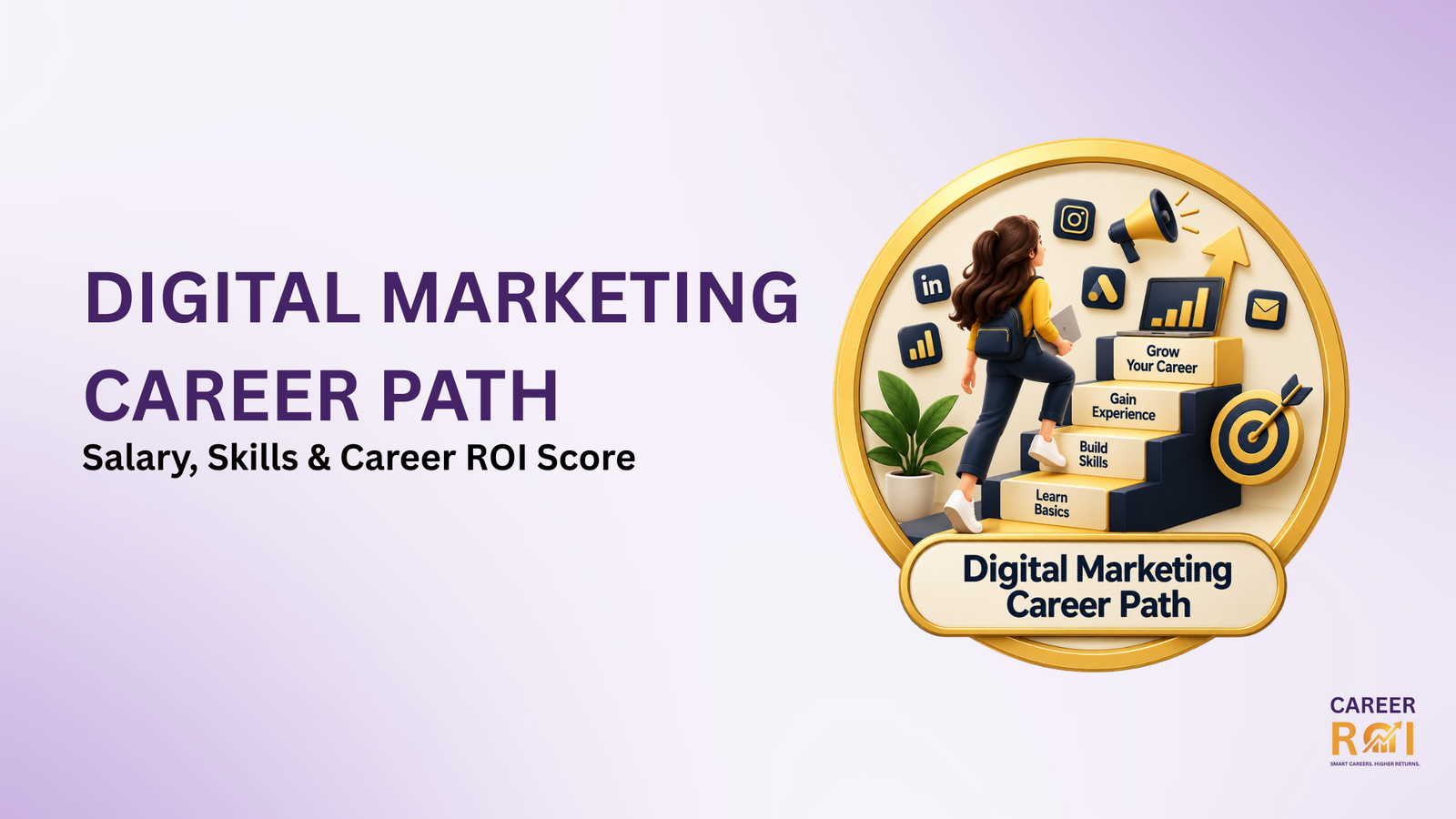
At some point, almost every student or career-changer in India has the same thought: “Digital marketing seems easy to get into — maybe I should just start there.”
It’s an understandable thought. The entry bar looks low. The course ads are everywhere, promising six-week transformations and “become a digital marketer” certificates. And unlike a lot of specialized careers, you don’t need an engineering degree or a CA to get your foot in the door.
But here’s what the course ads don’t tell you: digital marketing has one of the widest pay gaps of any career path in India, not because the field is unfair, but because it rewards specific skills disproportionately, and punishes generalist thinking almost as hard. Some digital marketers plateau around ₹5-6 LPA for years. Others cross ₹25-40 LPA before 30. The difference isn’t luck. It’s what you actually get good at.
Let’s break down exactly what separates the two.
What Does a Digital Marketer Actually Do?
“Digital marketing” is really an umbrella term for a dozen different specializations that all share one goal: getting the right message in front of the right person, and proving it worked.
Depending on your specialization, a normal week might involve:
- Running and optimizing paid ad campaigns (Google Ads, Meta Ads) against a budget and a target ROI
- Researching keywords and improving a website’s organic search ranking
- Planning and executing content or social media calendars
- Analyzing campaign data to figure out what’s working and reallocating spend accordingly
- Increasingly in 2026: using AI tools to speed up research, content drafts, and campaign optimization, while knowing when not to trust the AI’s output
The common thread across every specialization is measurability. Unlike a lot of marketing work a decade ago, almost everything you do in digital marketing today can be tracked, tied to a number, and judged on ROI, which is exactly why the field rewards people who think in outcomes, not activity.
Digital Marketing Salary in India (2026)
The salary range in digital marketing is unusually wide, wider than most career paths, because generalist and specialist roles sit at very different pay tiers, even at similar experience levels.
| Level | Experience | Salary Range (CTC) |
| Fresher (Generalist Executive) | 0–1 years | ₹2.5 – 4 LPA |
| Fresher (Specialist: Performance/SEO/Analytics) | 0–1 years | ₹3.5 – 6 LPA |
| Mid-Level Specialist | 2–5 years | ₹8 – 15 LPA |
| Senior Specialist / Manager | 5–8 years | ₹15 – 28 LPA |
| Head of Digital / VP Marketing | 9+ years | ₹40 LPA – 1 Cr+ |
A few important nuances behind this table:
- Generalists plateau early. Someone who stays a “digital marketing executive” doing a bit of everything, like a little SEO, a little social media, or a little content, tends to top out around ₹6-8 LPA. Specialists in high-accountability areas like performance marketing, SEO, or analytics regularly cross double that at the same experience level.
- AI fluency is now a measurable salary multiplier. Industry compensation data shows AI-skilled digital marketers earning 25-40% more than non-AI-fluent peers doing the same job. At entry level, the gap can be even sharper, with AI-capable freshers commanding significantly higher starting offers than those without.
- Freelancing has real upside. Because results are measurable, digital marketing is one of the most freelance-friendly fields in India — experienced freelance specialists can out-earn salaried peers, especially once they build a client base and case studies.
- City still matters, but specialization matters more. A generalist in Bengaluru will often earn less than a strong performance marketing specialist in a Tier-2 city, because clients and companies pay for outcomes, not geography.
Skills That Actually Move Your Salary
Here’s the uncomfortable truth about digital marketing: “knowing digital marketing” isn’t a skill. Everyone applying to entry-level roles claims that. What actually separates a ₹4 LPA offer from a ₹8 LPA offer is depth in one or two specific areas, not breadth across all of them.
Skills with the strongest salary correlation:
- Performance marketing (Google Ads, Meta Ads): the ability to run campaigns against a real budget and prove positive ROI is one of the most consistently well-paid specializations in the entire field.
- SEO (technical + content): genuinely valuable because results compound over time and directly affect a company’s most important asset, which is organic, non-paid traffic.
- Data analytics (GA4, dashboards, basic SQL): the skill that turns “I ran a campaign” into “I ran a campaign that improved conversion by 18%,” which is the sentence that actually gets you promoted.
- AI tool fluency for marketing workflows: not just using ChatGPT casually, but knowing how to use AI to speed up research, generate and refine content, and optimize campaigns faster than a non-AI-fluent peer.
- Copywriting / content strategy: undervalued by many aspiring marketers, but genuinely difficult to do well, and disproportionately rewarded when you can write copy that actually converts.
- Basic client or stakeholder communication: especially for agency roles, where your ability to explain performance data to a non-technical client determines how much trust (and budget) you’re given.
The real lesson: pick one specialization and go deep in your first 2 years, instead of staying a well-rounded generalist. Breadth is useful later, once you already have a strong, provable specialty to lead with.
How to Break Into Digital Marketing
The good news: this is genuinely one of the more accessible career paths to enter, regardless of your degree.
- Certifications help you learn, not just get hired. Google’s own certifications (Google Ads, Google Analytics) and platform-specific certifications (Meta Blueprint) are free or low-cost and give you a structured foundation, but the certificate alone won’t get you hired without proof of application.
- Build a portfolio, even without a job. Run a small ad campaign for a local business, optimize a friend’s blog for SEO, or manage a small brand’s Instagram. Real, even tiny, results beat a stack of certificates in an interview.
- Internships convert fast in this field. Because agencies and startups often need hands-on execution help immediately, digital marketing internships convert to full-time offers more readily than in many other fields if you can show initiative and results during the internship.
- Pick your specialization early, but don’t panic if you start generalist. Most people enter as generalists and specialize within their first 12-18 months once they discover which part of the work they’re actually good at and enjoy.
Career ROI Score: Digital Marketing
Overall ROI Score: 7.6 / 10 (varies significantly by specialization, see below)
| Factor | Rating | Why |
| Earning Potential | 7/10 | High ceiling for specialists (25-40 LPA+), but generalists plateau early. This is a bimodal career, not a smooth curve. |
| Time to Entry | 9/10 | One of the most accessible fields to break into, regardless of degree background |
| Job Security | 6/10 | Roles are plentiful, but generalist positions are increasingly automatable by AI tools, raising the bar for what “valuable” looks like |
| Skill Transferability | 8/10 | Data literacy, campaign strategy, and communication skills transfer well into broader marketing, growth, and even product roles |
| Long-Term Growth | 8/10 | Clear path to Head of Digital, CMO, or founding your own agency/consultancy |
| Work-Life Balance | 6/10 | Agency roles can be demanding with tight deadlines; in-house and specialist roles tend to offer more balance |
Who this career rewards: people who are comfortable with numbers and creativity in the same breath, who enjoy testing and iterating rather than getting things right the first time, and who are willing to specialize deeply instead of staying comfortably broad.
Who this career will frustrate: people looking for a stable, predictable routine, or those who want to stay purely creative without ever touching a spreadsheet or a performance metric. The “soft,” purely creative version of this job is shrinking fast.
FAQs: Digital Marketing Career Path
Q1. Is digital marketing a good career choice in India for 2026?
Yes, particularly for specialists. Demand is high and growing; India’s digital advertising market continues to expand double digits year on year, but the career rewards depth in one specialization far more than broad, generalist knowledge.
Q2. Do I need a degree in marketing to get into digital marketing?
No. Digital marketing is one of the most degree-agnostic career paths available; certifications, portfolios, and demonstrated results matter more to most employers than your specific degree.
Q3. Which digital marketing specialization pays the most in India?
Performance marketing (paid ads/PPC) and SEO consistently rank among the highest-paying specializations, especially when combined with strong data analytics skills. Emerging AI-search-related specializations are also commanding early premiums.
Q4. How important are AI skills for digital marketers right now?
Very. Current compensation data shows AI-fluent marketers earning 25-40% more than non-AI-fluent peers in comparable roles. This gap is one of the fastest-widening salary differentiators in the field right now.
Q5. Is freelancing a realistic option in digital marketing?
Yes, more so than in many other fields, because campaign results are measurable and portable across clients. Experienced freelance specialists can match or exceed salaried compensation once they build a client base.
Q6. How long does it take to go from fresher to a well-paying specialist role?
Typically 2-4 years, if you specialize early and can show measurable results (campaigns you ran, rankings you improved, conversions you drove) rather than staying a generalist for too long.
Closing Thoughts
Digital marketing has a reputation problem it doesn’t fully deserve, often being dismissed by some as “not a real skill” because the entry bar looks low. But the field’s low entry bar and its high ceiling aren’t contradictions. They’re the same fact, viewed from two different points in a career.
Anyone can enter. Not everyone chooses to go deep enough to matter. The people plateauing at ₹5-6 LPA for years and the people crossing ₹25 LPA before 30 often started at the exact same entry-level desk; the only real difference is what they decided to get relentlessly good at, and how early they made that decision.
You don’t need to know your specialization on day one. But the sooner you stop trying to be good at everything, and start trying to be excellent at one thing, the sooner this career starts paying you back for the effort you’re already putting in.