Somewhere in your third semester, a quiet panic sets in.
You look around at placement statistics, LinkedIn posts about “landing my dream job,” and seniors who graduated a year ago and are still job hunting, and you start wondering if your degree alone is actually going to be enough.
It’s a fair thing to wonder. Because here’s the truth nobody puts on the brochure: your degree gets you an interview. Your skills get you the job.
This isn’t meant to scare you; it’s meant to hand you a map. The students who walk out of college with real offers, not just real certificates, almost always did one thing differently: they spent their college years building a skill portfolio alongside their degree, not waiting until final year to panic-learn everything in six weeks.
Let’s build that map properly.
Why “Just the Degree” Isn’t Enough Anymore
This isn’t a dig at your degree; it’s a reflection of how hiring has changed. In 2026, most entry-level job descriptions list a degree as a baseline requirement, not a differentiator. Everyone applying has one. What separates the shortlisted candidates from the rest is what they can actually do on day one.
Companies are increasingly hiring for demonstrated skills, not just qualifications, because a degree tells them you completed a syllabus, but a skill tells them you can create value immediately, with less hand-holding and lower training cost.
That’s the real ROI lens here: every side skill you learn in college is an investment that starts paying you back the moment you walk into an interview room.
What Makes a Side Skill Actually Worth Learning
Not all skills are created equal, and not everything trending on your Instagram feed deserves your limited college hours. Before picking a skill, run it through three filters:
- Is it in demand right now, not two years ago, not hypothetically in the future?
- Can you prove it with a project, a certificate, a portfolio, something tangible?
- Does it stack with your degree, amplifying what you’re already studying, rather than existing in an unrelated silo?
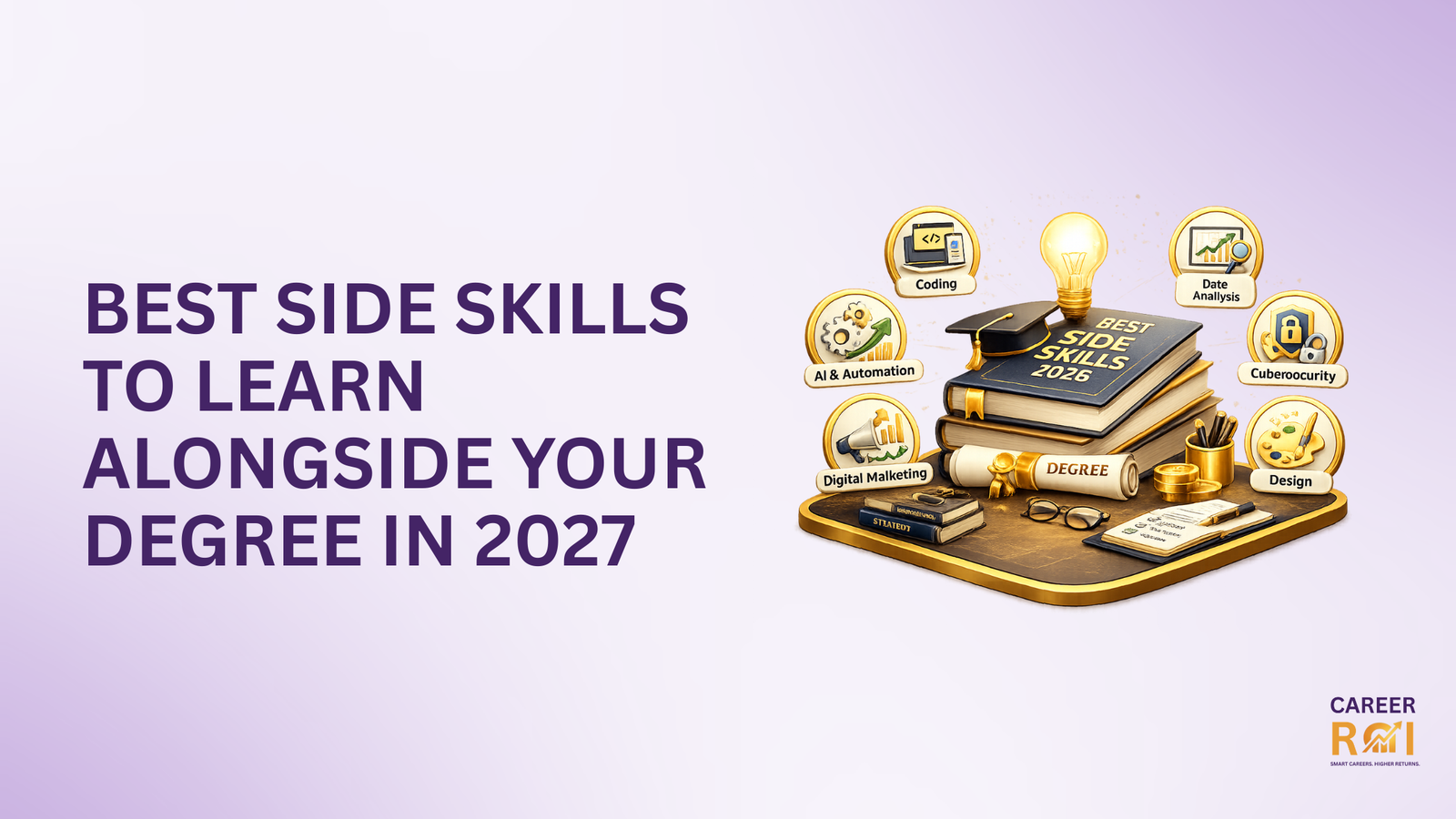
With that filter in mind, here are the side skills genuinely worth your time in 2026.
1. AI Tool Fluency (Not Just “Knowing ChatGPT Exists”)
Every industry (marketing, finance, design, engineering, HR) is being reshaped by AI tools. But “I’ve used ChatGPT” isn’t a skill anymore; everyone has. What actually stands out is knowing how to use AI tools to do your specific domain’s work faster and better, such as prompt engineering for your field, using AI for data analysis, automating repetitive tasks, or building simple AI-powered workflows.
Why it matters: Employers aren’t looking for AI experts at entry level. They’re looking for people who won’t need to be taught the basics of working alongside AI, because that’s already the baseline expectation in most modern workplaces.
2. Basic Data Skills (Excel, SQL, or Data Visualization)
Regardless of your degree (commerce, engineering, humanities, science), almost every job today involves some form of data: reading it, interpreting it, presenting it. You don’t need to become a data scientist. You need to be data-literate.
Start with:
- Advanced Excel (pivot tables, formulas, dashboards)
- Basic SQL (enough to query and understand a database)
- A visualization tool like Power BI or Tableau (even at a beginner level)
Why it matters: A finance student who can build a clean dashboard, or a marketing student who can pull and interpret campaign data, is instantly more useful than one who can only describe concepts theoretically.
3. Communication & Business Writing
This one gets overlooked because it feels “obvious,” but it’s one of the most consistently underdeveloped skills among fresh graduates. Being able to write a clear email, structure a report, or explain a complex idea simply is a skill that compounds across every single career path.
Why it matters: Technical skills get you shortlisted. Communication skills get you promoted. Nobody trusts someone with great ideas they can’t explain clearly.
4. A Design Tool (Canva, Figma, or Basic Video Editing)
You don’t need to become a designer. But basic visual literacy, like knowing how to put together a clean presentation, a simple social post, or a basic prototype, is a quiet superpower across marketing, product, HR, and even technical roles that need to communicate ideas visually.
Why it matters: In a resource-constrained team (which is most teams), the person who can also make things look presentable without needing a dedicated designer becomes disproportionately valuable.
5. Public Speaking & Presentation Skills
Every promotion, every leadership opportunity, every client-facing role eventually requires you to stand in front of people, physically or on a video call, and make a case for something. Most students avoid this until they’re forced into it. The ones who build it early have a massive head start.
Why it matters: Confidence in front of a room isn’t a personality trait you’re born with. It’s a trained skill, and it’s one of the rare skills that directly correlates with how fast people get noticed for leadership roles.
6. Financial Literacy (Personal Finance, Not Just Your Subject)
Regardless of what you’re studying, understanding how salary structures work, how to budget, how to start investing early, and how compounding works isn’t optional life knowledge anymore; it’s a career skill. It affects the offers you evaluate, the negotiations you’re willing to have, and the financial runway you build to take career risks later.
Why it matters: The students who understand their own finances make better, less desperate career decisions; they can afford to wait for the right opportunity instead of grabbing the first one out of financial anxiety.
7. One Niche, Deep Skill Tied to Your Field
Alongside these broad, transferable skills, pick one thing specific to your field and go deep, not wide. A CS student learning cloud basics, a marketing student getting genuinely good at SEO or performance ads, or a finance student learning financial modeling. This is the skill that turns “I have a degree in X” into “I can actually do X.”
Why it matters: Breadth gets you noticed. Depth gets you hired.
How to Actually Fit This In (Without Burning Out)
You don’t need to learn all seven simultaneously, and you definitely don’t need to sacrifice your mental health or your actual coursework to do it. A realistic approach:
- Pick 2-3 skills max per academic year, not seven at once
- Learn in short, consistent blocks (3-4 hours a week beats a chaotic 40-hour weekend binge)
- Always build something with what you learn (a project, a mini-portfolio, a small freelance gig); proof beats certificates
- Use semester breaks for deeper dives, and regular semester time for lighter, steady practice
The goal isn’t to exhaust yourself chasing every trend. It’s to walk out of college with 2-3 genuinely strong, provable skills stacked on top of your degree, not a scattered list of half-finished courses.
FAQs: Side Skills to Learn in College
Q1. Which side skill has the best ROI for most students in 2026?
AI tool fluency and basic data skills (Excel/SQL) currently offer the broadest ROI, because they apply across almost every industry and are increasingly treated as baseline employability skills, not specializations.
Q2. Should I focus on skills related to my degree, or explore unrelated ones?
Both, but not equally. Spend most of your time on skills that stack with your degree (deepening your core value), and a smaller portion exploring adjacent or broad skills like communication or AI tools that apply everywhere.
Q3. Do I need paid courses, or are free resources enough?
Free resources (YouTube, official documentation, free tiers of tools) are genuinely enough for 80% of these skills at a beginner-to-intermediate level. Paid courses help mainly with structure and certification credibility, not necessarily better knowledge.
Q4. How do I prove these skills to a recruiter if I don’t have work experience yet?
Build small, real projects (a dashboard, a portfolio site, a case study, a freelance gig) and put them on your resume and LinkedIn. Recruiters trust demonstrated work far more than a list of course names.
Q5. Will learning too many side skills make my resume look unfocused?
It can, if they’re random. The fix is a clear narrative: “I studied X, and I built Y and Z skills to apply it better” reads as focused. A random list of unrelated certifications reads as scattered.
Q6. Is it too late to start if I’m already in my final year?
No, but it does mean prioritizing ruthlessly. Pick one or two high-ROI skills, go deep enough to build one solid project, and let that carry your resume, rather than spreading yourself across everything on this list.
The Closing Thought
Nobody hands you a syllabus for the skills that actually decide your first job. You have to notice the gap yourself, usually somewhere between a rejection email and a friend’s success story, and then quietly decide to close it.
That’s exactly what you’re doing right now, reading this. That instinct, to prepare a little earlier than you had to, to build something extra when you didn’t need to, is the same instinct that will separate your first job search from everyone else’s.
Your degree is the entry ticket. These skills are what make the room actually remember you.
Start with one. Build something real with it. Then start the next.