
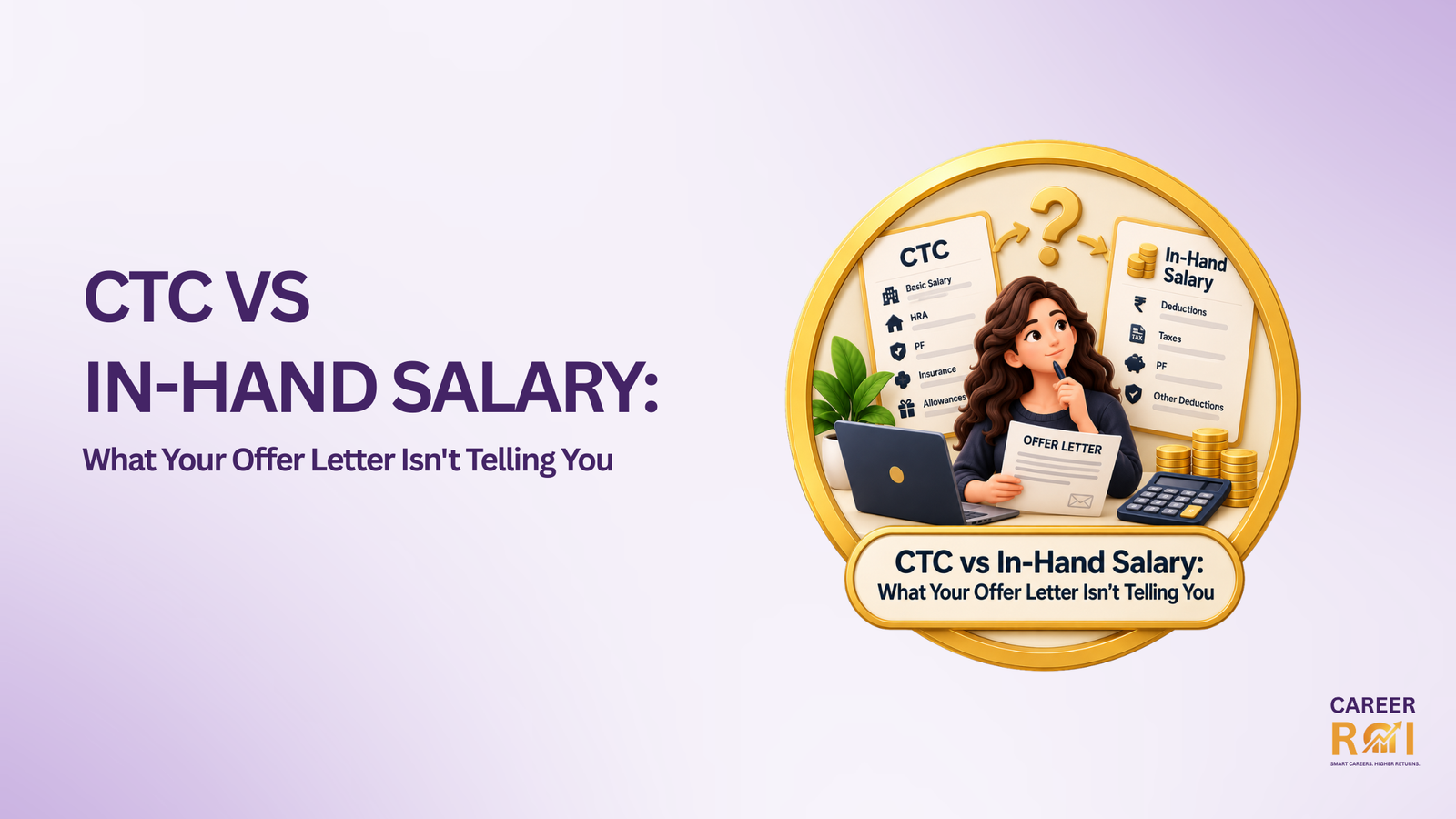
You just got the offer letter. ₹12 LPA.
You screenshot it. You send it to your parents. You send it to the group chat with three fire emojis. For about six hours, you are the main character.
Then payday happens. And ₹12 LPA turns into a monthly credit of ₹78,000.
You do the math again. And again. And somewhere between disbelief and mild betrayal, you ask the question every working Indian eventually asks:
“Where did the rest of my salary go?”
Nowhere. It was never yours in the first place — you just didn’t know that when you accepted the offer. This is the CTC vs in-hand salary gap, and it catches almost everyone once. Let’s make sure it doesn’t catch you twice.
What Is CTC? (Cost to Company, Explained Simply)
CTC (Cost to Company) is not what you earn. It’s what you cost your employer — every rupee they spend on you in a year, bundled into one big, impressive-looking number.
That number includes:
- Your basic salary
- HRA (House Rent Allowance)
- Special allowances
- Employer’s PF contribution (money that goes to your retirement fund — you don’t see it monthly)
- Gratuity (a legally mandated payout, but only if you stay 5+ years)
- Insurance premiums the company pays on your behalf
- Performance bonuses (often variable — meaning not guaranteed)
- Sometimes even meal cards, joining bonuses, or ESOPs
CTC is the total cost of employing you. It’s a recruiter’s number, not a bank-balance number. And that’s exactly why offer letters lead with it — a bigger number closes the deal faster.
What Is In-Hand Salary? (The Number That Actually Matters)
In-hand salary (or take-home salary) is what actually lands in your bank account every month, after every deduction has taken its cut.
The formula, roughly:
In-Hand Salary = Gross Salary − (Employee PF + Professional Tax + Income Tax/TDS) − any other deductions
This is the number you’ll use to pay rent, split with roommates, save, invest, or send home. It’s smaller than CTC. Sometimes a lot smaller — and the gap tends to widen as your CTC grows, because higher salaries pull in more tax and often a bigger variable component.
Why the Gap Exists (And Why It’s Not a Scam)
Here’s the part nobody explains at orientation: CTC is not designed to mislead you — but it is designed to look good.
A few structural reasons your in-hand will always be less than your CTC:
- Employer PF contribution (usually 12% of basic) — this goes straight into your retirement account, not your bank account. It’s your money, but it’s locked away for later.
- Gratuity — counted in your CTC on day one, but you legally can’t touch it unless you complete 5 years at the company. Leave in year 3, and you forfeit it.
- Variable pay / performance bonus — often 10-20% of CTC, shown as guaranteed income in the offer letter, but actually tied to appraisal ratings, company performance, or targets you haven’t even started working toward yet.
- Income tax (TDS) — the biggest chunk for most professionals earning above the basic exemption limit. This one’s non-negotiable, and it scales up fast as your income grows.
- Insurance and other employer-paid benefits — valuable, but not liquid cash you can spend.
None of this is illegal or unusual — it’s standard structuring across almost every company in India. The problem isn’t the structure. The problem is that most offer letters never walk you through it, and most candidates are too excited (or too nervous) to ask.
The Real Formula: How to Estimate Your In-Hand From CTC
You don’t need a finance degree — just a rough gut-check before you accept an offer. A reasonable ballpark:
In-Hand Salary ≈ 65–75% of CTC for salaries between ₹6–15 LPA (varies with tax slab, PF, and variable component)
Above ₹20 LPA, this ratio often drops closer to 60–65%, because tax outgo increases disproportionately.
Quick gut-check questions to ask before you sign:
- What % of my CTC is fixed vs variable?
- What is the employer PF contribution, and is it included in my CTC?
- Is gratuity included in this number? (It almost always is — and it shouldn’t sway your decision.)
- Is there a joining bonus or relocation allowance bundled into the headline figure?
- What does the actual monthly credit look like — can HR share a sample payslip structure?
That last question is the one 90% of candidates never ask. It’s also the one that matters most.
Why This Matters More Than You Think
This isn’t just a math lesson. It’s a financial ROI lesson, and getting it wrong early has compounding costs.
- You budget your rent, EMIs, or move-out plans around a number that was never real.
- You compare two job offers on CTC alone and pick the lower-paying one without realizing it, because one company structures variable pay aggressively and the other doesn’t.
- You negotiate a “hike” that’s mostly inflated by a bigger variable component — and your actual monthly cash flow barely moves.
Every rupee of CTC that isn’t in-hand is a rupee you can’t act on today — even if it’s genuinely valuable long-term (like PF or gratuity). Knowing the difference isn’t cynicism. It’s financial self-defense.
FAQs: CTC vs In-Hand Salary
Q1. Is CTC the same as gross salary? No. Gross salary is your CTC minus employer contributions like PF and gratuity. Gross salary still has income tax and employee PF deducted from it — in-hand salary is what’s left after that.
Q2. Why is my in-hand salary so much lower than my CTC? Because CTC includes non-cash and deferred components — employer PF, gratuity, insurance, and often variable bonus pay — none of which show up in your monthly bank credit.
Q3. Does a higher CTC always mean a better offer? Not necessarily. A company offering ₹10 LPA with 90% fixed pay may give you more monthly cash flow than one offering ₹11 LPA with a 25% variable component. Always compare fixed CTC, not headline CTC.
Q4. What is a good in-hand to CTC ratio? Anywhere between 65–75% is typical for early-to-mid career professionals in India. If your ratio is significantly lower, ask HR to break down where the gap is coming from — it’s often the variable pay or a large “special allowance” bucket.
Q5. Can I negotiate for more fixed salary instead of variable pay? Yes, and you should — especially early in your career, when predictable cash flow matters more than a discretionary bonus that depends on ratings you don’t yet control.
Q6. Is gratuity really part of my salary? Legally, yes — but only if you complete 5 years with the employer. If you’re likely to switch jobs before then (most professionals under 30 do), don’t count it as real income when evaluating an offer.
The Closing Thought
Nobody sits you down before your first job and teaches you to read a salary structure. You learn it the hard way — usually on your first payday, doing quiet math on your phone, wondering if you did something wrong.
You didn’t. The offer letter just told you one number when there were three worth knowing: what the company spends on you, what you actually take home, and what you keep after your own goals — rent, savings, family, the life you’re actually trying to build.
The next time an offer letter lands in your inbox, don’t just look at how big the number is. Look at how honest it is. Ask for the breakup. Ask for the fixed component. Ask what a real payslip looks like.
That one conversation — five extra minutes before you sign — is the highest-ROI negotiation you’ll ever have with yourself.